About Ravencharm Rattery

Located in San Tan Valley, Arizona
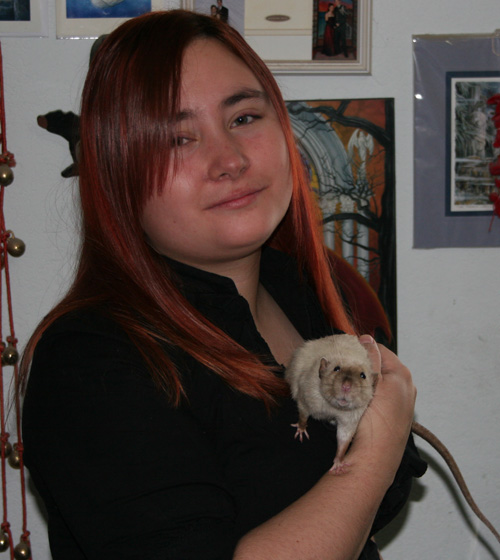
I am breeding because of my love for rats and my desire to improve their health, temperament, longevity and conformation through careful pairing. Rats will be available for pets, first and foremost, and may be used as breeders to established ratteries with written permission. I believe that rats make one of the most wonderful pets and can be a great addition to many families. They are intelligent, loving and lots of fun to have! I will only breed once I have an ideal pair and a full waiting list of adopters.Look at the testimonials to see what past adopters have to say about Ravencharm rat(s).
Goals
- Great Pets
- Superior Health
- Outstanding Temperament
- Improved Longevity
- Ideal Conformation
I am breeding in order to produce rats that will make wonderful pets and live long, healthy lives. Rats will also be bred for improved colors, markings and structure...after health, temperament and longevity.
Varieties
- D’Argent (Silvermane)
- Downunder
- Essex
- Frosted
- Marten (Red-eyed Devil)
- Odd-eyed Fawn
- Pearl
- Siamese Sable (Tonkinese)
- Spotted Tabby
- Whiteside
Ethics
Breeding Guidelines
- Rats are first, and foremost, pets
- Rat must meet health, temperament and conformation requirements to be considered for breeding
- Bucks are bred no earlier than 12 months (This is my ultimate goal, though I have found bloodline foundation has required earlier buck breeding in order to make the best pairs in terms of temperament and health)
- Does are bred no earlier than 6 months
- A doe will not exceed 2 breedings in her lifetime
- Does who exhibit difficulty while giving birth or maternal aggression will be excluded from our breeding program
- Does are given at least 8 weeks after weaning before being bred again
- Rats who exhibit illness or aggression are excluded from my breeding program
- Rats must be in peak physical condition and pass a series of temperament tests before being bred
Breeding Process
- Pairs are selected based on complimentary features, as to not intensify any one fault
- Buck and doe will be paired when doe comes into heat
- Rats are returned to their colony after breeding
- Doe is moved into nursery on the 20th day from first breeding
- Doe is returned to colony 5 weeks after birth
Litters
- Babies are briefly checked daily to ensure they are receiving enough milk and are developing properly
- Weekly the babies are evaluated for conformation and temperament so I can make my selections and decide which babies will go to pet homes
- Babies are separated by gender at 5 weeks
- Those that have been reserved are placed with their new families at 8 weeks
- Selected babies are kept for 12 weeks to monitor temperament and conformation development
- Babies who do not make final cut will be available for placement in new homes if deemed ideal for pet placement
- Those who are selected will be kept as potential breeders and evaluated for ideal temperament, conformation and health into adulthood
Placing Rats in Homes
- Potential adopters are required to fill out an adoption application
- Applications will be reviewed to determine good homes
- A deposit is required for babies to be reserved
- Live rats are never sold as feeders
- Rats are placed in pairs unless proof of compatible cage mate is given
- Rats are placed as pet only, meaning they are not to be bred unless written approval is given by me
- Rats are to be returned to Ravencharm Rattery if new home does not work out or if new owner can no longer care for them
- I do not rehome rats that have been used in my breeding program as I continue monitoring their health and temperament throughout their life
Diet
I'm currently feeding Mazuri Rodent Breeder 6F. For variety they also receive a dry mix, as well as fresh fruits and veggies. I give probiotics in the form of supplemented baby rice cereal.
The dry mix is: a variety of oats, sunflower seeds, pumpkin seeds, fruit flavored baby puff grain snacks, dried fruit (bananas, papaya, golden raisins, raisins, pineapple), low-sugar rice puffs and low-sugar toasted whole grain oat cereal.
Rattery Setup
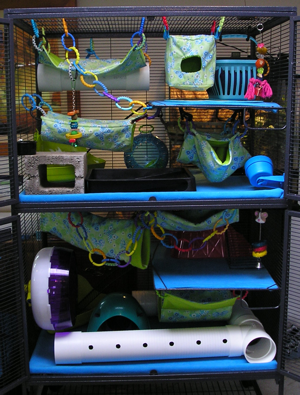
I have several Midwest Critter Nation cages and Midwest Ferret Nation cages, they are all double units (36"L x 24"W x 63"H), which I use for my main rattery housing. I also have a few smaller cages and custom tub cages, which are used for the quarantine of new rats or for a nursery for litters.
The rats also get playtime outside of their cage, which includes fun activities like diving for peas and carrots.